Published by:
CGP EDU Academic Team
Published on: September 12, 2026
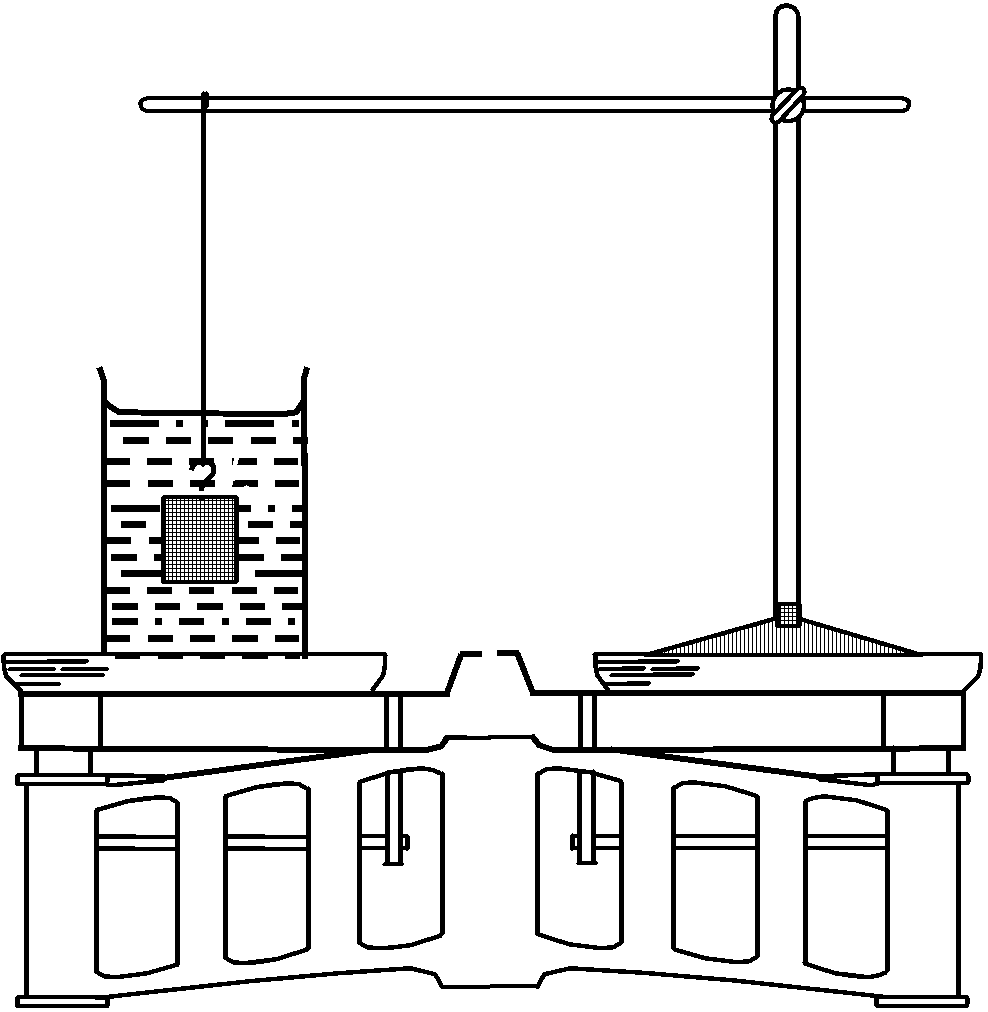
On one scale-pan of a pair of scales is a vessel containing water, and on the other is a stand, from the arm of which a body is suspended by a weightless thread (Fig.). While the body is not in the water, the scales are in equilibrium. Then the thread is lengthened so that the body is entirely immersed in the water. As a result, equilibrium is destroyed. What should be done to restore equilibrium?
Text Solution
Verified by ExpertsThe correct answer is:
A
Step 1: Understand the initial condition.
Initially, when the body is not submerged in the water, the weights on both sides of the scale are balanced. The weight of the vessel with water equals the weight of the suspended body.
Step 2: Analyze the situation when the body is submerged.
When the body is fully immersed in the water, it experiences an upward buoyant force equal to the weight of the water displaced by the body. According to Archimedes' principle, this buoyant force is present because the body is displacing some volume of water.
Step 3: Determine the forces at play.
As the body is immersed, its effective weight is reduced by the buoyant force. This means the scale pan with the water (which measures the weight of the water along with the buoyant force acting upwards on the submerged body) becomes lighter compared to the suspended body.
Step 4: Restoring equilibrium.
To restore equilibrium, either the amount of water in the vessel needs to be increased (which increases the downward force on the scale with the water) or the weight of the suspended body needs to decrease (which can be done by lowering the mass). Since the system initially balanced in weight, adding water to the vessel compensates for the buoyant force acting on the suspended body, thus restoring the equilibrium.
Conclusion: Increase the amount of water in the vessel to restore equilibrium.
Initially, when the body is not submerged in the water, the weights on both sides of the scale are balanced. The weight of the vessel with water equals the weight of the suspended body.
Step 2: Analyze the situation when the body is submerged.
When the body is fully immersed in the water, it experiences an upward buoyant force equal to the weight of the water displaced by the body. According to Archimedes' principle, this buoyant force is present because the body is displacing some volume of water.
Step 3: Determine the forces at play.
As the body is immersed, its effective weight is reduced by the buoyant force. This means the scale pan with the water (which measures the weight of the water along with the buoyant force acting upwards on the submerged body) becomes lighter compared to the suspended body.
Step 4: Restoring equilibrium.
To restore equilibrium, either the amount of water in the vessel needs to be increased (which increases the downward force on the scale with the water) or the weight of the suspended body needs to decrease (which can be done by lowering the mass). Since the system initially balanced in weight, adding water to the vessel compensates for the buoyant force acting on the suspended body, thus restoring the equilibrium.
Conclusion: Increase the amount of water in the vessel to restore equilibrium.
Prepare Smarter with CGP Edu
Get practice questions, solutions, and test series in one place.
Write a Review
Share your experience with this question and solution.
Commentary
Send your comment, doubt, correction, or feedback to admin.
Similar Questions
Explore conceptually related problems
A U-tube in which the cross-sectional area of the limb on the left is one quarter, the limb on the …
A wooden block, with a coin placed on its top, floats in water as shown in fig. the distance l and …
A body floats in a liquid contained in a beaker. The whole system as shown falls freely under gravi…
A liquid is kept in a cylindrical vessel which is being rotated about a vertical axis through the c…
Water is filled in a cylindrical container to a height of 3m. The ratio of the cross-sectional area…
A large open tank has two holes in the wall. One is a square hole of side L at a depth y from the t…